

Ask most church boards how many events they held last year and they can tell you. Ask how many people took a real step closer to Jesus because of those events, and the room gets quiet.
That silence isn’t a lack of faithfulness. Most churches are full of people working hard. What’s missing is a shared picture of what all that work is for. Without one, every ministry runs its own race: the potluck team measures the potluck, the VBS team measures VBS, and nobody is watching whether the family who came to VBS ever comes back.
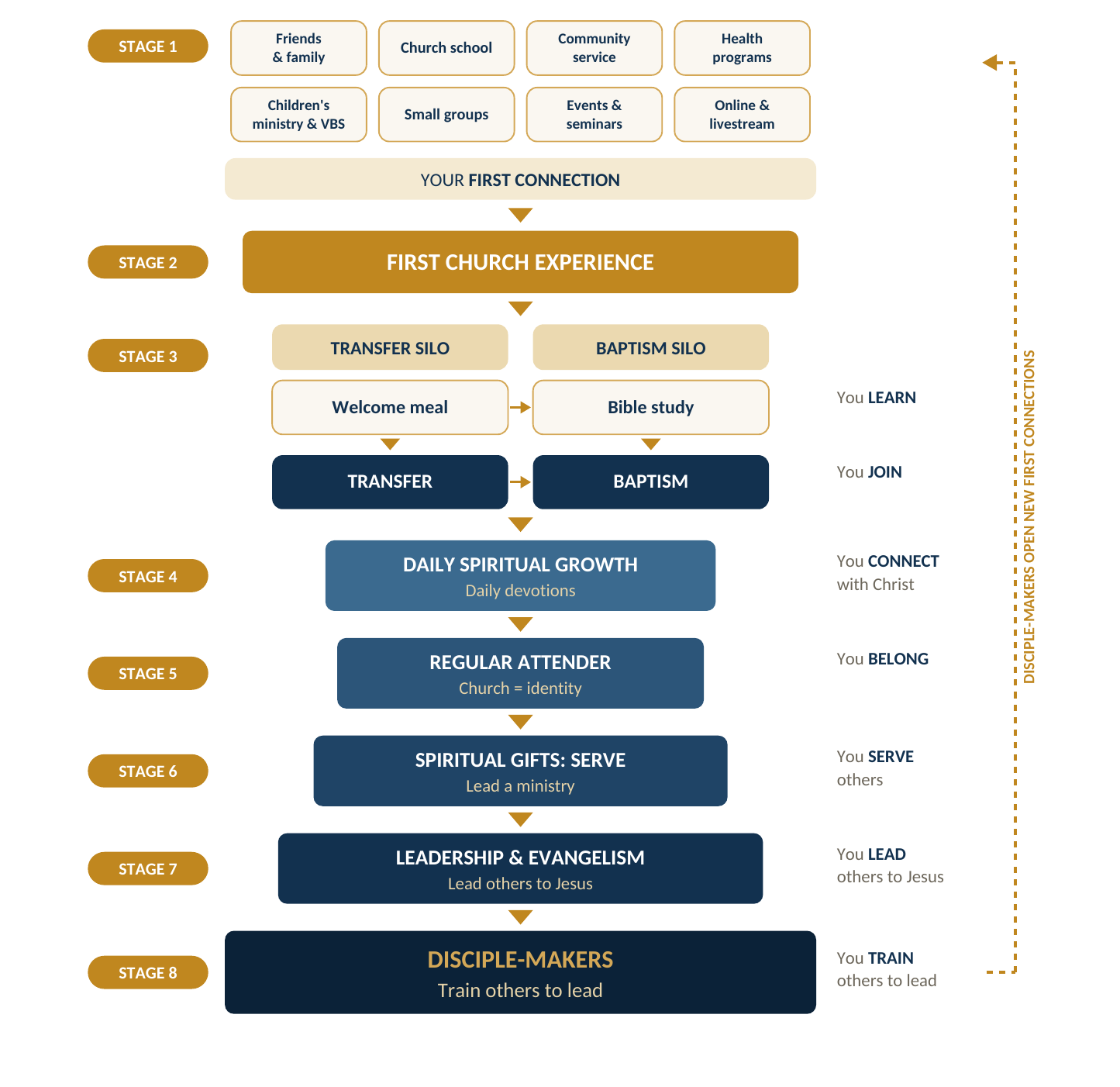
The Pathway for Making Disciples is that shared picture. It puts the church’s entire disciple-making process on one page.
The Great Commission is a pathway
Jesus didn’t ask His church to gather crowds. He gave us a process:
“Go ye therefore, and teach all nations, baptizing them in the name of the Father, and of the Son, and of the Holy Ghost: teaching them to observe all things whatsoever I have commanded you.”
Matthew 28:19–20, KJV
Go. Make disciples. Baptize. Keep teaching. That’s not a single event; it’s a journey. And Jesus modeled every step of it:
“Christ’s method alone will give true success in reaching the people. The Saviour mingled with men as one who desired their good. He showed His sympathy for them, ministered to their needs, and won their confidence. Then He bade them, ‘Follow Me.’”
Ellen G. White, The Ministry of Healing, p. 143
Mingling, ministering, winning confidence, then “Follow Me.” The Pathway simply names those steps so that every ministry in the church can see where it fits.
The eight stages
Stage 1 — Your first connection. Almost nobody’s first contact with a church is a worship service. It’s a friend or family member, the church school, a community service day, a health program, a small group, an event, Vacation Bible School, or a livestream. These are the church’s front doors.
Stage 2 — First church experience. The first time someone steps inside the life of the church family. What happens here decides whether there will be a second time.
Stage 3 — You learn, and you join. Here the path splits into two tracks. Believers coming from another congregation are welcomed, often around a meal, and become part of the family through transfer. Those discovering Jesus and His truth study the Bible personally and are invited to baptism. Both tracks arrive at the same place: joining the family of God.
Stage 4 — Daily spiritual growth. You connect with Christ. Prayer and time in His Word become a daily habit, not a Sabbath-only experience.
Stage 5 — Regular attender. You belong. Church stops being a place you visit and becomes part of who you are.
Stage 6 — Spiritual gifts: serve. You serve others. Members discover how God has gifted them and begin to serve, and some lead a ministry.
Stage 7 — Leadership and evangelism. You lead others to Jesus. Members don’t only run ministries; they personally bring people toward Christ.
Stage 8 — Disciple-makers. You train others to lead. This is the finish line: people who are discipled, making disciples, and training others to make disciples.
The pathway is a circle, not a chute
Notice where Stage 8 leads: back to Stage 1. Disciple-makers are the people who open new first connections. They invite the neighbor, start the new small group, and bring a coworker to the community dinner. A church that stops at Stage 5 fills its pews. A church that reaches Stage 8 multiplies.
That’s why our work is not done when someone is baptized, or even when they’re faithfully serving. Our work is not done until every person is discipled, making disciples, and training others to make disciples.
Everyone is somewhere
This is the most freeing truth on the Pathway. The visitor at the health seminar is somewhere on it. So is the transfer member, the teenager in the back row, and the elder who has served for forty years. Nobody is finished, and nobody is off the map. Every person has a next step, and every ministry exists to help someone take it.
Every ministry moves people one step
Once a church sees the Pathway, a simple question changes how it plans: what step is this designed to move people toward?
- An event for people having their first experience with the church should be designed around one goal: a second experience. That means warm follow-up, a reason to return, and a personal invitation before they leave.
- An evangelistic series designed to help people make a decision for baptism should build every night toward that decision, with Bible studies ready for anyone who says yes.
- A fellowship ministry designed to turn casual attendees into regular attenders should build belonging, and invite people into something that meets every week.
If a plan can’t name the step it serves, it’s worth asking whether it should be on the calendar at all.
People are lost in the handoffs
Here’s what most churches miss: we rarely lose people inside a stage. We lose them between stages. The first-time guest nobody calls. The new member nobody invites to serve. The Bible study that ends without anyone asking for a decision.
So every step on the Pathway needs someone who owns the handoff, a real name, with a simple rule: follow up within 48 hours. When every handoff has an owner, the Pathway stops being a poster and starts being a process.
A note on order
People don’t always move in a straight line. Some worship faithfully for years before they’re baptized. Some begin daily devotions long before they join. The Pathway shows the direction of growth, not a checklist to complete in sequence. The goal is always the same: meet people where they are, and invite them to their next step.
How to put the Pathway to work in your church
- Map every ministry. At your next board meeting, list every ministry and recurring event and name the step each one serves. You’ll quickly see where five ministries overlap and where a step has none.
- Name the handoff owners. For every step, write down who follows up and how fast.
- Ask members where they are. The free guide includes a “Where am I on the Pathway?” page. Hand it out on a Sabbath and let every member name their own next step.
- Plan with it. Every ministry leader can use the Pathway inside the Blueprint Hour, a five-question, 90-day planning worksheet built around it.
Free Download
Pathway for Making Disciples: Leader Guide
The full-page Pathway poster, a stage-by-stage handoff chart, a ministry-mapping worksheet for your board, Event Design Cards, and a “Where am I on the Pathway?” page for members. Free to copy for your church.
Get the Free GuideThe finish line
Jesus’ final words to His disciples weren’t “fill the building.” They were “make disciples.” Every person who comes in contact with your church is somewhere on that journey. Your ministry’s job is to help them take the next step, and to keep going until they’re helping someone else take theirs.
— Pastor Myckal Morehouse